
Global Seminar in Mexico

Printmaking and Social Justice in Oaxaca

Explore the intersection of art, culture, and social change through a Global Seminar that combines on-campus studio work at Temple with an immersive field experience in Oaxaca, Mexico over spring break. Through critical inquiry and creative practice, you will examine how throughout history, printmaking has served as a powerful medium for political expression, community organizing, and cultural preservation. Specifically, the course will focus on protest graphics - from revolutionary pamphlets and political posters to contemporary street art and memes. In the studio you will learn or refine (depending on your experience) two printmaking techniques (letterpress, relief printing, and/or screen printing). While in Oaxaca, you will engage with artists, printmaking workshops, Indigenous communities, and cultural organizations to investigate how art intersects with struggles for land rights, environmental sustainability, labor, and cultural identity. No prior printmaking experience is required.  

Program Overview

Expand upon each of the links below to view more details about this program.

Academic Program

LANGUAGE OF INSTRUCTION

English

COURSE LOAD 

1 course, 3 credits

COURSE OFFERINGS

You will take the following course:

  • Art 2701 Protest Graphics (3 credits)

This course is an approved option for the Honors Social Justice Minor.

Academic Program

In this course, you will see examples of prints from all over the world, bringing a global perspective into both the history of printmaking and also the diversity of contemporary printmaking studios and the contexts in which they emerge. Printmaking has a long legacy of co-existing within and alongside social movements, often allowing communities to amplify their concerns in a manner that is visually engaging and not dependent on corporately owned media outlets. Similarly, the projects completed in this course will allow you to articulate your own concerns, to grapple with aesthetic strategies, and to engage in contemporary dialogues on human rights and environmentalism. 

To contextualize the history of social justice printmaking in Oaxaca, you will learn about indigenous organizing, the ecological history of the region, the 2006 Teacher’s Uprising, mining in the region, and local craft traditions. Learning will take place through readings, presentations from local experts, and numerous site visits. 

Your final project (either a portfolio of original prints or a research paper incorporating photographs and visual analysis) will respond to a contemporary social justice issue inspired by the people, places, and topics encountered in Oaxaca.

Location

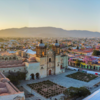
Located in a valley in southeastern Mexico surrounded by rugged mountain ranges, Oaxaca is the capital and largest city in the state of Oaxaca, with a metropolitan population of approximately 768,000 people.

Explore Oaxaca!

Oaxaca occupies a compelling intersection of profound social history, vibrant culture, and complex political dynamics. As one of Mexico's great historic cities, its urban core and the nearby ancient capital of Monte Albán collectively form a UNESCO World Heritage site that anchors a region defined by endless possibilities for exploration. The state holds the greatest biodiversity in the country and is home to 16 recognized Indigenous groups—most notably the Zapotec and Mixtec cultures—giving it the highest percentage of Indigenous residents in Mexico. Many of these residents continue to hold and manage their land communally, making the region a central site for ongoing debates around Indigenous autonomy, land rights, and extractive industries.

This deep heritage blends with centuries of Spanish influence to create a unique multicultural identity reflected in local street processions, public plazas, traditional music, and vibrant textiles. Beyond its political history, Oaxaca is internationally known for its rich culinary arts, featuring world-renowned culinary districts famous for complex moles and artisanal mezcal, as well as traditions like the Day of the Dead.

View the map of Oaxaca.

Program Dates

Course Duration: January – May (with required Spring Break travel to Oaxaca) 

Tentative International Travel Dates

 Spring 2028
Departure from U.S.TBD
Arrival in MexicoTBD
OrientationTBD
Last night in housingTBD
Program concludesTBD

Do not use the above dates to book your flight, as they are tentative and subject to change. Accepted students will receive confirmed program dates and flight booking guidelines from Education Abroad before making travel plans.  

Program participants are required to be present for the entire length of the program, from the official arrival date through the program end date.

Housing

Housing type: Hotel or Hostel

Basic hotel or hostel (shared, single-sex bedrooms) in Oaxacafor the duration of the program. If you have documented accommodation with Disability Resources & Services for a single room, please contact Education Abroad when you apply for the program. 

Activities & Excursions

The on-site partner provides a comprehensive orientation upon arrival, in collaboration with the Temple Program Director.

Throughout the program, you will participate in numerous required cultural activities and excursions designed to demonstrate how printmaking has served as a powerful medium for political expression, community organizing, and cultural preservation.

Faculty & On-site Support

Temple Faculty

A Temple faculty member serves as the program director overseeing the academic program and will serve as your point of contact for academic matters.

View program faculty.

On-site Support

In addition to your program director, you will have support from our on-site partner.

Program Costs

PROGRAM DEPOSIT

Students will pay a non-refundable program deposit of $400 within 2 weeks of acceptance to the program. This non-refundable deposit is credited to your program fees as a prepayment. 

TUITION AND FEES

Temple students pay their usual spring semester tuition and fees by school/college and residency.

All students pay:

  • Global Seminars Program Fee: $2,500 (Includes airfare, housing, required program activities, and some meals abroad.)

For complete details about billable costs and estimates for non-billable expenses while abroad. 

View detailed program costs.

SCHOLARSHIPS AND FINANCIAL AID

Learn more about scholarships and financial aid.

Health & Safety

Staying healthy and safe abroad requires good planning and strong support. Review our health and safety page for important steps to prepare to study abroad, and details about international travel medical insurance and assistance provided by Temple. 

Contact

Global Seminar Eligibility

Temple Global Seminars are open only to matriculated Temple University students. 

You are eligible to apply if you meet the following requirements.

Are enrolled fulltime and will have completed 1 semester before studying abroad
  • You are enrolled as a full-time matriculated student at the time of application until the end of the Global Seminar.
  • You will have completed at least one (1) semester of college-level study by the program start.
Are in good academic standing and meet minimum GPA requirement for the program
  • You meet the minimum cumulative GPA requirement from all colleges/universities attended. The GPA requirement for Temple Global Seminars is 2.5 on a 4.0 scale.
  • You remain in good academic standing from the time of application until the start of the semester of the Global Seminar; students on academic warning are not eligible to participate.
Have a valid passport

A copy of your passport will be required by the October 15 commitment deadline .Your passport cannot expire for at least 6 months after you return from your trip abroad. 

Are in good disciplinary standing

You must be in good disciplinary standing at the time of application and remain so through the start of your travel abroad. Students who have been found responsible for a code of conduct violation and will not be in good disciplinary standing (including disciplinary probation) may submit a petition for review.

Meet the minimum age requirement

You are at least 18 years old at the time of application.

For the Global Seminar in Mexico, there are no additional eligibility requirements. The program is open to students of all majors and experience levels. 

Application Requirements

The standard application requirements pertain to all students applying to Temple programs.

    For the Global Seminar in Mexico, applicants are asked to answer a short essay question (250 words) detailing their interest in the program. 

    Admissions Timeline

    Temple students may apply up to the standard application deadline. Application review will begin after the application deadline, not on a rolling admissions basis. After the application deadline, you should expect a decision within (2) weeks.